
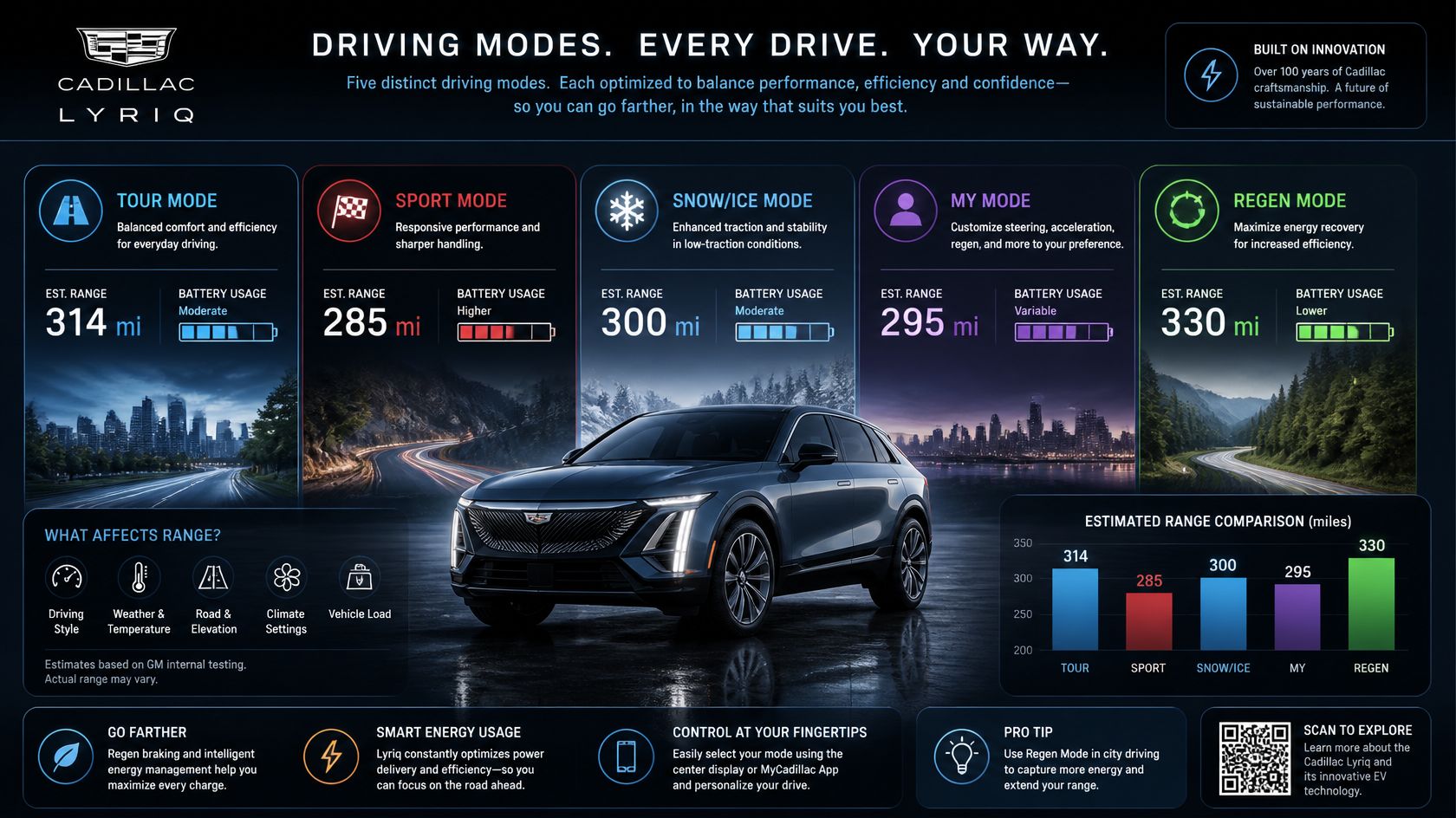

The Cadillac LYRIQ combines luxury, electric performance, and advanced technology in a premium all-electric SUV. However, many owners and prospective buyers have an important question: do the driving modes in Cadillac LYRIQ offer different ranges or battery usages? The answer is yes, indirectly. Driving modes can influence how the vehicle responds to acceleration, manages traction, and delivers power. These changes can affect energy consumption and the distance you travel on a single charge.
However, selecting a different mode does not automatically change the battery’s physical capacity or guarantee a specific reduction in driving range. Your speed, driving habits, outside temperature, climate control settings, and road conditions also play major roles.
This guide explains how Tour, Sport, Snow/Ice, and My Mode can affect the Cadillac LYRIQ’s battery efficiency. You will also learn how to estimate range differences, improve everyday efficiency, and follow practical charging habits without relying on unsupported mileage claims.
Understanding the Cadillac LYRIQ’s Driving Modes
The Cadillac LYRIQ uses selectable driving modes to adjust aspects of the vehicle’s driving behavior. Depending on the model year, trim, powertrain, and equipment, these settings can influence throttle response, steering feel, traction control behavior, and other driving characteristics.
For electric vehicle owners, the important distinction is between power delivery and energy consumption. A mode that makes the accelerator feel more responsive does not necessarily consume more electricity when the driver maintains the same speed and follows the same driving pattern. In practice, however, a more aggressive response can encourage faster acceleration, which may increase energy use.
The LYRIQ’s driving modes should therefore be viewed as tools for adapting the vehicle to different situations rather than fixed battery-efficiency settings. Exact features and customization options can vary by model year. Consult the owner’s manual for your specific LYRIQ to confirm which modes and adjustments are available.
1. Tour Mode
Tour Mode is generally the most suitable starting point for everyday driving. It provides a balanced driving experience designed for commuting, errands, and longer trips. For drivers who want predictable acceleration and comfortable road manners, this mode is a practical default.
Tour Mode can support efficient driving when it helps you accelerate smoothly and maintain a steady speed. However, it is not a guarantee of maximum range. A driver who repeatedly accelerates hard in Tour Mode may use more energy than someone who drives gently in another mode. Regenerative braking, road speed, and weather can have a greater influence on the final result than the mode selection alone.
2. Sport Mode
Sport Mode emphasizes a more responsive driving experience. Depending on the LYRIQ’s configuration, selecting it can make acceleration feel sharper and the vehicle feel more engaging behind the wheel.
The main efficiency concern is driver behavior. Quick acceleration demands substantial electrical power, and repeated bursts of acceleration can increase battery consumption. Although electric motors can deliver strong torque immediately, that performance still draws energy from the battery. Drivers who use Sport Mode without taking advantage of its extra responsiveness may see little difference in consumption compared with their usual driving. The result depends on how the vehicle is driven, not simply on the mode name.
3. Snow/Ice Mode
Snow/Ice Mode is designed to help the vehicle behave more predictably on slippery roads. Its purpose is to support controlled driving on surfaces where excessive wheel torque or sudden inputs can compromise traction.
In these conditions, traction and safety matter more than achieving the lowest possible energy consumption. Gentle acceleration and smoother power delivery can help prevent wheelspin and unnecessary energy loss. Nevertheless, cold temperatures, wet or snowy pavement, winter tires, and increased rolling resistance can all affect range. Snow/Ice Mode does not eliminate these effects, and it should not be treated as a dedicated battery-saving mode.
4. My Mode
My Mode allows drivers to personalize aspects of the LYRIQ’s driving experience where supported by their model and equipment. Depending on the available settings, it may let you tailor characteristics such as steering feel or accelerator response.
Its effect on battery consumption depends on the configuration you choose and how you respond to it. A setup that encourages smooth acceleration and relaxed driving may support good efficiency. A more responsive setup, combined with frequent hard acceleration, may increase energy use. Because customization options can differ across model years, there is no single My Mode configuration that guarantees the longest range for every LYRIQ.
How Driving Modes Impact Battery Usage and Range
Driving modes affect the experience of operating an electric vehicle, but their influence on range is not always direct. Battery energy is consumed by the electric drive system, climate control, electronics, and other vehicle systems. The amount required to cover a mile depends on operating conditions and driving behavior.
A mode may change how quickly the vehicle responds to the accelerator or how traction is managed. Those changes can influence energy use if they lead to different acceleration patterns or driving conditions. However, a selectable mode does not create additional battery capacity. The most useful comparison is therefore the vehicle’s measured electricity consumption over similar routes, rather than an assumption that one mode always provides a particular percentage improvement.
Tour Mode and Battery Efficiency
Tour Mode can be a strong choice for drivers who prioritize comfortable, consistent everyday travel. Smooth acceleration, steady speeds, and early anticipation of traffic can help reduce unnecessary energy demand.
To assess its real-world efficiency, track the LYRIQ’s energy consumption over several comparable trips. Use the vehicle’s available efficiency display, trip information, or charging records to compare electricity use. Keep the route, approximate speed, temperature, and climate control settings as similar as possible. This method offers more useful evidence than comparing two unrelated journeys and attributing every difference to the driving mode.
Sport Mode and Battery Consumption
Sport Mode can use more energy when its sharper response leads to frequent rapid acceleration. The vehicle needs additional electrical power to increase speed quickly, and aggressive driving may also create more opportunities for braking that cannot be fully recovered through regeneration.
However, Sport Mode does not automatically drain the battery faster under every condition. Maintaining a steady cruising speed can require similar energy in different modes when the operating conditions are comparable. Aerodynamic drag, tires, road gradients, and speed remain important factors. Drivers should judge the effect of Sport Mode by observing actual consumption rather than assuming that its performance-oriented character always produces a large range penalty.
Snow/Ice Mode and Battery Usage
Snow/Ice Mode prioritizes controlled driving on slippery surfaces. Smooth power delivery may reduce wheelspin and help the driver maintain traction. This can be useful when snow, ice, or slush makes ordinary driving more challenging.
Winter conditions can still increase electricity consumption considerably. Cold batteries may operate less efficiently, cabin heating requires energy, and snow-covered roads can increase resistance. These effects can reduce the distance available from a full charge even if Snow/Ice Mode itself is not the main cause. When planning a winter trip, allow extra range and pay attention to the vehicle’s estimated remaining distance rather than expecting a specific result from the selected mode.
My Mode and Battery Usage
My Mode offers flexibility, but its efficiency depends on the available adjustments and the driver’s habits. If the configuration encourages measured acceleration and a comfortable driving pace, it can be suitable for routine travel.
There is no universal energy-saving setting that applies to every LYRIQ configuration. For example, changing steering feel alone should not be assumed to produce a measurable improvement in range. If your model permits adjustments that affect power response, compare the results using the same route and conditions. Personalization is most valuable when it creates a driving experience that naturally supports smooth, predictable inputs.
Quantifying the Impact on Range
The question of how much range each driving mode adds or removes deserves a careful answer. Cadillac’s advertised driving range is an estimate tied to the vehicle’s configuration and standardized testing, not a guarantee for every trip. The Environmental Protection Agency (EPA) publishes estimated range and efficiency figures for specific vehicle configurations, while actual results vary with weather, speed, terrain, and other conditions.
Without controlled, model-specific testing, it would be misleading to claim that Tour Mode adds a fixed number of miles or that Sport Mode reduces range by a precise percentage. A more reliable approach is to measure energy consumption in kilowatt-hours per 100 miles (kWh/100 mi) or miles per kilowatt-hour (mi/kWh), where those readings are available.
Tour Mode
Tour Mode provides a useful baseline for measuring everyday efficiency. Start with a fully charged battery, record the trip distance and energy consumption, and note the outside temperature and climate control settings. Repeat the process on comparable routes to reduce the effect of random differences.
If the vehicle reports 3.0 mi/kWh during one test, for example, that means it traveled three miles for each kilowatt-hour consumed over that measured period. This is an illustrative calculation, not a claimed Cadillac LYRIQ test result. Your measured efficiency can then help you estimate how much energy a future trip may require.
Sport Mode
To evaluate Sport Mode, repeat the same route under similar conditions and compare the measured consumption with the Tour Mode baseline. Try to keep cruising speed, traffic exposure, cabin temperature, and tire pressures consistent.
If consumption rises, consider whether you accelerated harder or drove faster during the test. Those changes may explain the difference more convincingly than the mode selection alone. A fair comparison separates the mode’s effect on vehicle behavior from the driver’s response to that behavior. This is particularly important when testing a high-performance electric SUV, because small differences in acceleration and speed can meaningfully change energy demand.
Snow/Ice Mode
Snow/Ice Mode is difficult to compare fairly with other modes because it is often used in different weather and road conditions. A winter trip may involve colder air, slippery surfaces, snow buildup, and more cabin heating than a summer journey.
For that reason, a lower winter range should not automatically be attributed to Snow/Ice Mode. Compare trips only when conditions are reasonably similar, and prioritize safe operation over efficiency testing. If your vehicle consumes more energy in winter, examine temperature, heating use, speed, and road conditions before drawing conclusions about the selected mode.
My Mode
For My Mode, first identify which settings your particular vehicle allows you to change. Record the configuration, then compare its consumption with Tour Mode on a familiar route.
A meaningful test should change one variable at a time whenever possible. If you adjust accelerator response, steering, and other settings together, it becomes difficult to identify which change affected the result. Remember that a single trip cannot establish a dependable percentage difference. Repeated measurements under comparable conditions provide a more useful estimate for your driving routine.
Practical Considerations
Choosing the right driving mode begins with the conditions you expect to encounter. Tour Mode is a sensible default for normal travel, Sport Mode is useful when you want a more responsive feel, Snow/Ice Mode is appropriate when slippery conditions call for its traction-focused behavior, and My Mode offers personalization where available.
However, the best mode for maximum range is not necessarily the one with the most relaxed label. A driver who uses Sport Mode smoothly may achieve better efficiency than someone who accelerates aggressively in Tour Mode. Focus on smooth inputs, sensible speeds, and traffic awareness. In winter, leave additional range in reserve and use the mode suited to the road conditions.
You should also avoid making conclusions from the dashboard range estimate alone. The displayed distance is a prediction that can change as the vehicle gathers information about recent driving, temperature, and energy use. A changing estimate does not necessarily mean that battery capacity has suddenly increased or decreased. Use measured consumption over time for a clearer picture of efficiency.
Additional Factors Affecting Range and Battery Usage in the LYRIQ
Driving modes are only one part of the Cadillac LYRIQ’s energy picture. The battery must supply power for propulsion and support other electrical systems, so even two trips using the same mode can produce different results. Understanding the factors below can help you identify why your real-world range differs from the estimated figure.
1. Driving Style: The Hidden Influence on Efficiency
Driving style can have a substantial effect on electric vehicle consumption. Hard acceleration increases power demand, while repeated braking may waste energy that could have been avoided by anticipating traffic and slowing smoothly.
Regenerative braking helps recover some kinetic energy when the vehicle decelerates, depending on the selected settings and operating conditions. It does not recover all the energy used to accelerate. Leave enough following distance, look ahead, and avoid unnecessary speed changes. These habits can improve efficiency regardless of whether you choose Tour Mode, Sport Mode, Snow/Ice Mode, or My Mode.
2. Speed and Highway Driving
Higher speeds usually increase aerodynamic drag, which means the vehicle needs more energy to maintain its pace. As a result, sustained high-speed highway travel may produce lower efficiency than slower driving on suitable roads.
This is why the same LYRIQ can deliver different ranges on two routes of equal distance. A trip with steady moderate speeds may require less energy than one involving prolonged high-speed travel, congestion, and repeated acceleration. Following posted speed limits and driving at a consistent, appropriate pace are practical ways to manage energy use without relying on a particular driving mode.
3. Environmental Conditions and Temperature
Temperature affects battery performance, cabin comfort, and charging. In cold weather, the battery may require thermal management, while heating the cabin can increase electricity use. Very hot weather can also require energy for cooling.
Preconditioning the cabin while connected to a suitable charger, when supported by the vehicle, can help reduce the energy drawn from the battery for initial heating or cooling. However, results depend on the temperature, charger, settings, and duration. In extreme weather, plan for a lower available range than you might expect under mild conditions, and check the LYRIQ’s displayed estimate before starting a long trip.
4. Terrain and Elevation Changes
Driving uphill requires additional energy because the vehicle must gain gravitational potential energy. Downhill travel can return some energy through regenerative braking, but recovery is not complete.
A route with steep climbs may therefore consume more energy than a flat route of similar length. Wind direction, road surfaces, tire rolling resistance, and vehicle load can further change the result. When comparing modes, choose a route with similar elevation and traffic patterns. Otherwise, terrain differences may overwhelm the small efficiency changes you are trying to measure.
Optimizing Battery Usage for Long-Term Health
Efficient driving and battery longevity are related, but they are not identical. Reducing unnecessary energy use can help you travel farther between charges, while sensible charging and thermal management can support the battery’s long-term operation. The most suitable charging routine depends on your LYRIQ model year, battery configuration, driving needs, and the guidance in Cadillac’s owner’s manual.
1. Charging Habits
Follow the charging recommendations specified for your vehicle. For everyday use, a moderate charging target may be practical when permitted by the owner’s manual and the vehicle’s battery-management system. Charging to 100% can be appropriate when you need the available range for a long journey, but avoid treating a full charge as necessary for every short commute.
Also, do not leave a battery at a very high or very low state of charge for extended periods unless the manufacturer’s instructions support the situation. Charging limits and battery-care guidance can differ by model and software version. Use the vehicle’s available charging controls to establish a routine that matches your actual travel needs.
2. Battery Preconditioning
Battery preconditioning manages battery temperature to help prepare the pack for driving or charging when the relevant feature is supported and activated. Its availability and operation can depend on the model year, software, navigation settings, and charging conditions.
When planning a DC fast-charging stop, follow Cadillac’s instructions for preparing the battery. Appropriate preconditioning can help the battery reach a suitable temperature for charging, particularly in cold conditions. Cabin preconditioning is a separate but related comfort feature that can reduce the need to draw as much energy from the battery after departure. Check the vehicle’s manual to understand which functions your specific LYRIQ supports.
3. Regular Maintenance
Electric vehicles need less routine powertrain maintenance than many gasoline vehicles, but tire condition, tire pressure, alignment, brakes, and software still matter. Incorrect tire pressure can increase rolling resistance, while alignment problems may affect efficiency and tire wear.
Follow Cadillac’s maintenance schedule and use tires that meet the vehicle’s specifications. Address warning messages promptly, and make sure software updates and service recommendations are handled through appropriate channels. A healthy, properly maintained vehicle is a better starting point for efficient driving than switching between modes in search of an unverified range improvement.
FAQs
Do Cadillac LYRIQ driving modes change the battery range?
Yes, they can affect real-world range indirectly by changing vehicle response and traction behavior. However, the impact depends on driving style and conditions; selecting a mode does not change the battery’s physical capacity.
Which LYRIQ driving mode is best for maximum range?
Tour Mode is a sensible starting point for everyday efficiency. Smooth acceleration, moderate speeds, appropriate tire pressure, and limited unnecessary climate-control use generally matter more than mode selection alone.
Does Sport Mode drain the LYRIQ battery faster?
It can use more energy when its responsive acceleration encourages hard driving. If you maintain similar speeds and driving patterns, the difference may be smaller than expected.
Does Snow/Ice Mode reduce LYRIQ range?
Not necessarily by itself. Winter temperatures, cabin heating, snow-covered roads, and reduced traction can increase energy use, so winter range may be lower even when Snow/Ice Mode is the appropriate choice.
How can I improve Cadillac LYRIQ battery efficiency?
Drive smoothly, maintain appropriate tire pressure, avoid unnecessary high speeds, precondition the cabin when practical, and monitor energy consumption. Follow Cadillac’s charging and maintenance recommendations for your model year.
Conclusion
So, do the driving modes in Cadillac LYRIQ offer different ranges or battery usages? They can influence real-world energy consumption, but there is no universal mileage difference that applies to every vehicle, driver, and road condition. Tour Mode offers a balanced starting point, Sport Mode can increase consumption when used aggressively, Snow/Ice Mode supports controlled driving on slippery surfaces, and My Mode allows personalization where available.
For the best results, focus on smooth acceleration, sensible highway speeds, temperature management, correct tire pressure, and appropriate charging habits. Compare energy use over similar routes instead of relying on assumptions or unsupported percentages. Ultimately, understanding how driving modes interact with your habits and environment is the most reliable way to manage Cadillac LYRIQ battery usage and make the most of every charge.

SEO specialist and content creator with 4 years of experience in search engine optimization, keyword research, and digital publishing. Passionate about creating high-quality, user-focused, and trending content for JournelTrends.com while helping readers discover valuable information online.
