
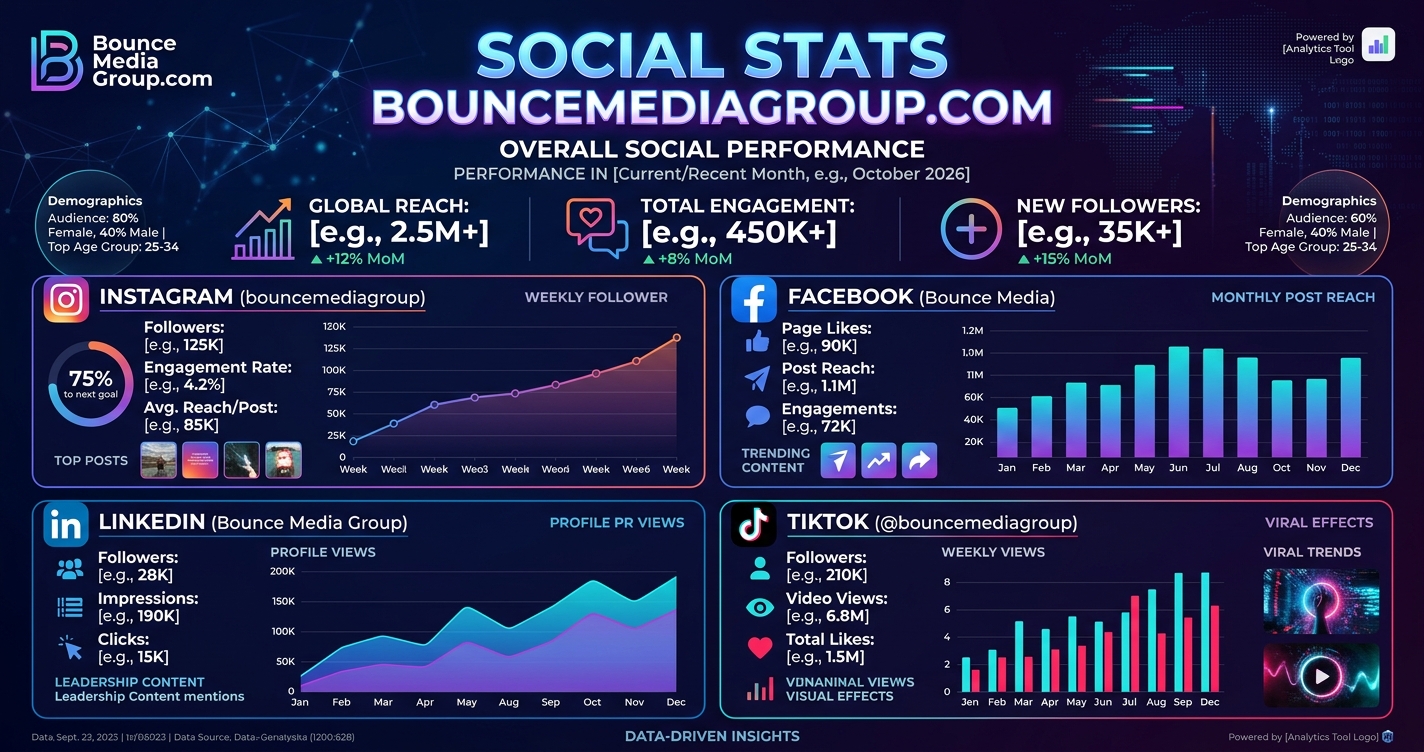

Social media has become an important part of modern communication, digital marketing, and business growth. Companies use platforms such as Facebook, Instagram, TikTok, LinkedIn, YouTube, and X to connect with audiences, promote products, and measure customer engagement. However, understanding social media performance requires more than counting likes and followers. Businesses also need reliable data about audience behavior, website traffic, content reach, and marketing trends. This is where social stats bouncemediagroup.com becomes a relevant search term for readers exploring social media statistics and digital industry information.
This guide explains what Bouncemediagroup.com social stats may refer to, how social media analytics work, and why accurate reporting matters. It also explores worldwide social media usage, digital performance metrics, industry news, emerging technologies, and practical marketing strategies. Because platform-specific statistics can change frequently, this article distinguishes established analytics principles from figures that require direct verification.
What Is Bouncemediagroupcom Social Stat?
Bouncemediagroupcom social stat is a search phrase associated with BounceMediaGroup.com and the idea of finding social media statistics, audience insights, marketing information, and digital performance data. People searching for this term may want to understand how social platforms perform, how brands build online audiences, or where they can find information about digital marketing developments.
However, the exact meaning of the phrase depends on the information available through the website. Without independently verified platform data or a confirmed analytics report, it would be inaccurate to claim that BounceMediaGroup.com publishes specific follower counts, engagement figures, or traffic measurements. Readers should check the website directly to establish which services, reports, and statistics it actually provides.
A useful way to approach this topic is to separate the website itself from the wider subject of social media analytics. The website may be the starting point for research, while established measurement tools provide additional ways to investigate performance. For example, Meta Business Suite offers insights for supported Facebook and Instagram accounts, YouTube Studio reports channel performance, and Google Analytics measures activity on websites and apps.
Why Are People Searching for BounceMediaGroup.com Social Statistics?
Digital marketers, business owners, content creators, and students often search for social statistics because they want to understand online performance. They may be researching a website, comparing digital marketing resources, or looking for information about audience growth and technology trends.
The search term can also reflect a broader interest in industry news and online business developments. Nevertheless, a keyword alone does not prove that a website offers a particular analytics dashboard or maintains a verified database. Readers should evaluate the actual pages, publication dates, sources, and available methodology before relying on information found online.
Understanding Social Media Statistics and Audience Analytics
Social media statistics are measurements used to understand how people interact with content and digital platforms. These measurements include follower growth, impressions, reach, video views, comments, shares, link clicks, and conversions. Each metric answers a different question. For example, reach estimates how many unique accounts saw content, while impressions count how often content was displayed. A single person may generate multiple impressions.
Audience analytics provides further context by examining demographic information where available, audience interests, viewing patterns, device usage, and engagement behavior. These insights help organizations understand who interacts with their content and which topics attract attention. However, demographic estimates are not always complete or representative of an entire audience, so marketers should interpret them carefully.
Important Social Media Metrics
| Metric | What it measures | Why it matters |
| Followers | Accounts following a profile | Indicates potential audience size |
| Reach | Unique accounts exposed to content | Helps measure distribution |
| Impressions | Total content displays | Shows how frequently content appears |
| Engagement rate | Interactions relative to a defined audience or exposure measure | Helps evaluate audience response |
| Click-through rate | Percentage of impressions or recipients that generate clicks, depending on the formula | Measures interest in a link or call to action |
| Conversions | Desired actions, such as purchases or sign-ups | Connects marketing activity to business results |
| Referral traffic | Website visits arriving from another source | Helps identify traffic sources |
| Audience retention | How long viewers continue watching content | Helps evaluate video quality and relevance |
These metrics should not be treated as interchangeable. A campaign may generate many impressions but few website visits. Another campaign may reach fewer people yet produce more sales. The right measurement depends on the campaign’s objective.
How to Calculate Engagement Rate
One common formula calculates engagement rate by dividing total interactions by reach and multiplying the result by 100.
Engagement rate by reach = (Total engagements ÷ Total reach) × 100
For example, if a post receives 240 engagements and reaches 6,000 unique accounts, its engagement rate by reach is 4%. This example illustrates the calculation rather than reporting the performance of any real BounceMediaGroup.com account.
Other formulas use impressions, followers, or video views as the denominator. Therefore, comparisons are meaningful only when the same formula and measurement period are used. A reliable social statistics report should explain its methodology.
How Many People Use Social Media Worldwide?
Social media reaches billions of people around the world, making it a major channel for communication, entertainment, education, and commerce. DataReportal’s Digital 2024 Global Overview Report, published in January 2024, estimated approximately 5.04 billion active social media user identities worldwide at the beginning of 2024. This was equivalent to roughly 62.3% of the global population at that time.
These figures are historical estimates, not current 2026 totals. They also refer to user identities rather than necessarily representing the same number of unique individuals. One person may maintain accounts on multiple platforms, and measurement providers use different methods to estimate usage. For the latest figures, readers should consult recent DataReportal reports and the original research cited within them.
Which Social Media Platforms Matter Most?
Different platforms serve different audiences and business goals. Facebook supports community building and broad consumer communication. Instagram focuses strongly on visual content, creators, and product discovery. TikTok emphasizes short-form video and recommendation-driven discovery. YouTube supports both short and long videos, while LinkedIn is widely used for professional networking and business communication.
WhatsApp and other messaging services support direct communication, customer service, and community interaction. Meanwhile, Pinterest can help users discover ideas and products, while Reddit supports interest-based discussions. Platform popularity varies by country, age group, industry, and purpose, so a worldwide ranking alone does not determine which channel a business should use.
Why Global Social Media Numbers Need Context
Worldwide user estimates can help businesses understand the potential scale of digital audiences. However, they do not automatically reveal the number of people who might purchase a product or respond to a campaign. Advertisers need to consider location, language, customer needs, platform access, and purchasing behavior.
For a U.S. business, national survey results and platform-specific audience tools may be more useful than a global total. Marketers should also check the reporting date and definitions behind every statistic. A trustworthy report identifies its source, explains what was measured, and avoids presenting estimates as exact counts of unique people.
BounceMediaGroup.com Social Stats and Digital Performance
Researching BounceMediaGroup.com social stats requires a clear distinction between verified website information and general digital performance analysis. A website’s name or a search result does not establish its audience size, monthly traffic, social media following, or engagement rate. These figures should be reported only when they are supported by reliable, dated evidence.
To investigate the website, begin with its official pages and available social profiles. Check whether the profiles are linked from the website, whether their branding matches, and whether recent posts show consistent activity. Public follower counts can provide a limited snapshot, but they do not reveal the full audience, actual reach, or the number of people who interact with each post.
How to Assess Website Traffic and Social Presence
Website traffic and social media performance are related, but they measure different activities. A website may attract visitors through search engines, direct visits, referral links, email campaigns, or paid advertising. Social media can be one source of traffic without being the largest source.
Tools such as Google Analytics can help authorized website owners examine sessions, engagement, traffic acquisition, and conversions. Search Console provides information about a site’s performance in Google Search, including impressions, clicks, and search queries. Third-party services may estimate traffic for public websites, but their results are modeled estimates rather than a substitute for first-party analytics.
A practical assessment of BounceMediaGroup.com should consider the following points:
- Website activity: Check whether pages are accessible, updated, and relevant to the site’s stated purpose.
- Social profiles: Verify official account links and review recent publishing activity.
- Audience growth: Compare public follower counts over time where historical records are available.
- Content engagement: Examine visible comments, shares, and reactions without assuming they represent the complete audience.
- Traffic evidence: Identify whether figures come from the site owner, an analytics provider, or an independent estimate.
- Reporting dates: Record when the information was collected.
This process helps readers avoid confusing general marketing information with confirmed performance data about a particular website.
What Can Public Statistics Reveal?
Public statistics can provide useful clues about content consistency, visible audience interest, and potential brand reach. However, they rarely reveal complete business performance. For instance, a profile may have a large following but limited sales, while a smaller account may attract highly relevant customers.
A balanced report should state its limitations. If verified figures for BounceMediaGroup.com are unavailable, the correct approach is to explain what can be checked and avoid inventing numbers. Transparency makes the analysis more useful to readers and supports responsible digital research.
Bouncemediagroup.com Industry News and Marketing Developments
Digital marketing changes quickly as platforms adjust their algorithms, advertising products, privacy rules, and content policies. Industry news helps marketers understand these changes and decide whether they need to update their strategies. Readers interested in Bouncemediagroup.com industry news should check the site’s current publications to determine which topics it covers and how recently its information was updated.
Important developments include changes to social media recommendations, creator monetization, paid advertising tools, social commerce, and digital privacy. For example, a change in how a platform recommends videos can affect organic reach. A new advertising measurement feature may also change how a business tracks campaign results. These developments should be confirmed through official announcements and reputable industry reporting before being used to make business decisions.
Where Should Readers Verify Digital Marketing News?
Reliable digital research starts with the original source whenever possible. Platform announcements explain product changes, while independent research can provide broader context. The following resources are useful starting points:
- Meta Newsroom: Official announcements concerning Meta products and services.
- Google Search Central: Guidance on Google Search, website visibility, and search updates.
- YouTube Official Blog: News about video products, creators, and platform features.
- TikTok Newsroom: Company announcements and product developments.
- DataReportal: Digital usage reports and social media estimates.
- Pew Research Center: Survey-based research on internet use and social media behavior in the United States.
Readers should distinguish a news article from an opinion piece or promotional post. They should also check the publication date, identify the original source of any statistics, and look for supporting evidence before repeating a claim.
Why Industry News Matters to Businesses
Timely information helps businesses recognize opportunities and avoid outdated tactics. A company may adjust its video format after reviewing current platform guidance, revise its advertising strategy following a policy change, or improve its privacy practices in response to new requirements.
However, not every reported trend deserves immediate action. Marketers should consider whether a development affects their audience, industry, or business goals. Testing a small change and measuring the results is often more useful than adopting a trend simply because it is popular.
Bouncemediagroup TechTrends and Emerging Technologies
Technology is changing how businesses create content, analyze audiences, and manage digital campaigns. Artificial intelligence, automation, predictive analytics, social listening, and improved attribution tools are becoming important parts of modern marketing. Readers exploring Bouncemediagroup TechTrends should verify the website’s current coverage rather than assume it publishes detailed reporting on every emerging technology.
Artificial intelligence can help marketers generate content ideas, classify customer feedback, summarize reports, and identify patterns in large datasets. However, automated tools can produce inaccurate statements, misinterpret context, or reflect limitations in their training data. Human review remains important, especially when content includes statistics, product claims, financial information, or advice that could affect customers.
Artificial Intelligence and Predictive Analytics
AI-supported analytics can help businesses organize data and identify changes in customer behavior. Predictive models may estimate which audiences are more likely to engage with a campaign or which content formats deserve further testing. These results are probabilities, not guarantees.
Businesses should use appropriate data permissions and review how their analytics providers collect, process, and retain information. Sensitive personal information should not be uploaded to tools without proper authorization. Companies should also check applicable privacy laws, contractual requirements, and platform policies before using customer data for automated targeting.
Automation, Social Listening, and Data Privacy
Marketing automation can schedule posts, organize campaign workflows, and trigger messages based on defined customer actions. Social listening tools can monitor public conversations, brand mentions, and common customer concerns. These features can help businesses respond more quickly and identify recurring issues.
Automation should not remove human oversight from customer communication. Scheduled messages can become inappropriate when circumstances change, while automated sentiment tools may misunderstand sarcasm or regional expressions. A strong technology strategy combines automation with human judgment, transparent data practices, and clear accountability.
For readers evaluating technology-related content on BounceMediaGroup.com, the same standards apply: verify the author, check supporting sources, distinguish established capabilities from experimental claims, and look for publication dates that match the pace of technological change.
Social Media Engagement, Traffic, and Business Growth
Social media can support business growth by increasing brand awareness, bringing visitors to a website, building customer relationships, and generating leads. However, results depend on the quality of the content, the relevance of the audience, and the effectiveness of the customer journey. A high follower count is not enough to prove that a campaign is successful.
An effective strategy begins with a clear objective. A local business may want more appointment bookings, while an online retailer may focus on purchases and repeat customers. A nonprofit may measure donations or event registrations. Each objective requires different metrics, and the selected indicators should reflect the outcome the organization wants to achieve.
Turning Engagement Into Website Traffic
To attract useful website traffic, businesses should publish content that addresses a real audience need. Educational videos, product demonstrations, expert explanations, customer stories, and practical guides can encourage users to explore a website. Clear calls to action help audiences understand the next step.
Links should lead to relevant landing pages rather than unrelated homepages. Businesses can also use campaign tracking parameters to identify traffic from specific social posts, advertisements, and creator partnerships. This information makes it easier to compare channels and understand which activities generate meaningful visits.
Nevertheless, social referral traffic should be evaluated alongside engagement quality and conversions. A large volume of visitors who leave immediately may be less valuable than a smaller group that reads product details, subscribes to a newsletter, or completes a purchase.
Measuring Return on Investment
Return on investment, or ROI, helps businesses compare the financial results of a campaign with its costs. A basic ROI calculation is:
ROI = [(Revenue attributed to the campaign − Campaign cost) ÷ Campaign cost] × 100
For example, if a campaign generates $3,000 in attributable revenue and costs $1,000, its ROI is 200% under this simplified calculation. The example assumes that the revenue attribution is reliable and does not account for every possible business expense.
Attribution can be difficult because customers often interact with multiple channels before buying. A person might discover a product on Instagram, search for the brand on Google, and later purchase through a direct website visit. Businesses should use consistent attribution rules and avoid claiming that one channel caused every sale.
Building a Sustainable Social Media Strategy
A sustainable approach prioritizes audience trust and useful content over short-term attention. Businesses should publish consistently, respond to genuine questions, correct misleading information, and review performance at regular intervals. They should also avoid buying fake followers or using deceptive engagement tactics, which can distort analytics and weaken credibility.
The most useful social statistics connect activity to a business outcome. For example, a company can compare qualified leads, email sign-ups, customer inquiries, and sales across campaigns. These measurements help teams decide where to invest their time and advertising budget.
How to Evaluate Social Statistics and Improve Marketing Strategies
Evaluating social statistics requires more than collecting numbers from dashboards. Marketers must confirm the source, understand the metric definitions, compare similar reporting periods, and determine whether the results support their objectives. This approach is particularly important when researching a website such as BounceMediaGroup.com, where the availability and accuracy of specific public performance figures should be confirmed before making claims.
Start by defining a measurable goal. Instead of saying that a brand wants better social media performance, set a specific target, such as increasing qualified website visits or improving the conversion rate of a campaign. Establish a baseline before making changes. Then measure results over a suitable period and account for factors such as seasonal demand, paid promotion, and changes in publishing frequency.
A Practical Social Media Evaluation Framework
Use the following steps to improve the quality of your analysis:
- Identify the source. Determine whether data comes from an official platform, a website owner, an independent research organization, or a third-party estimate.
- Check the date. Avoid comparing a recent weekly result with a year-old annual report without explaining the difference.
- Define the metric. Confirm how reach, impressions, engagement, traffic, and conversions are calculated.
- Choose relevant benchmarks. Compare your performance with similar campaigns, audiences, and platforms rather than unrelated accounts.
- Segment the results. Examine performance by content format, audience group, campaign, or traffic source where data permits.
- Test improvements. Change one or two variables at a time when practical, such as the opening of a video or the wording of a call to action.
- Document limitations. Record missing data, attribution issues, estimates, and assumptions.
- Review and refine. Use the findings to improve the next campaign rather than relying on a single result.
Common Mistakes to Avoid
One common mistake is treating correlation as proof of causation. If followers and sales increase during the same period, that does not automatically mean follower growth caused the sales increase. Advertising, seasonal demand, press coverage, or other changes may also contribute.
Another mistake is comparing engagement rates calculated using different formulas. A post measured by reach cannot be fairly compared with one measured by follower count unless the difference is clearly explained. Businesses should also avoid treating third-party traffic estimates as exact figures.
Finally, readers should be cautious about unsupported claims, missing publication dates, and statistics with no identifiable source. A credible social media report explains where the numbers came from and what they can reasonably show. These practices make social statistics more useful for business planning and reduce the risk of decisions based on misleading information.
Frequently Asked Questions (FAQs)
1. What is social stats Bouncemediagroup.com?
Social stats Bouncemediagroup.com is a search phrase related to social media statistics and digital performance information associated with BounceMediaGroup.com. Check the website directly to confirm its current content, available data, and reporting methods.
2. How can I check BounceMediaGroup.com social media statistics?
Start by reviewing the website’s official social links and public profiles. Check visible follower counts, posting activity, and engagement, and use reliable analytics sources when available to verify performance claims.
3. Does BounceMediaGroup.com provide accurate social media analytics?
Accuracy depends on the source, methodology, and date of the information. Verify any statistics against official platform data or credible research before relying on them. Specific analytics capabilities should not be assumed without confirmation.
4. Why are social media statistics important for digital marketing?
Social media statistics help businesses understand audience engagement, content reach, website visits, and conversions. These measurements support better campaign planning and help marketers identify which activities contribute to their business goals.
5. Which tools can help me measure social media performance?
Meta Business Suite, YouTube Studio, Google Analytics, and Google Search Console provide useful performance information for their supported services. The best tool depends on whether you need social engagement data, website traffic measurements, or search performance reports.
Conclusion
Understanding social stats bouncemediagroup.com requires a balanced approach to social media analytics, digital industry news, and online performance measurement. BounceMediaGroup.com may serve as a starting point for researching social statistics, but readers should verify the website’s current information before attributing specific traffic figures, audience counts, or analytics services to it.
Reliable marketing decisions depend on accurate data, clear measurement methods, and relevant business goals. Tools such as Meta Business Suite, YouTube Studio, Google Analytics, and Google Search Console can help users evaluate different aspects of digital performance. Meanwhile, industry research and official platform announcements provide useful context for changing trends. By checking sources, understanding key metrics, and reviewing results consistently, businesses and content creators can develop more effective digital strategies while avoiding misleading statistics and unsupported claims.

SEO specialist and content creator with 4 years of experience in search engine optimization, keyword research, and digital publishing. Passionate about creating high-quality, user-focused, and trending content for JournelTrends.com while helping readers discover valuable information online.
