
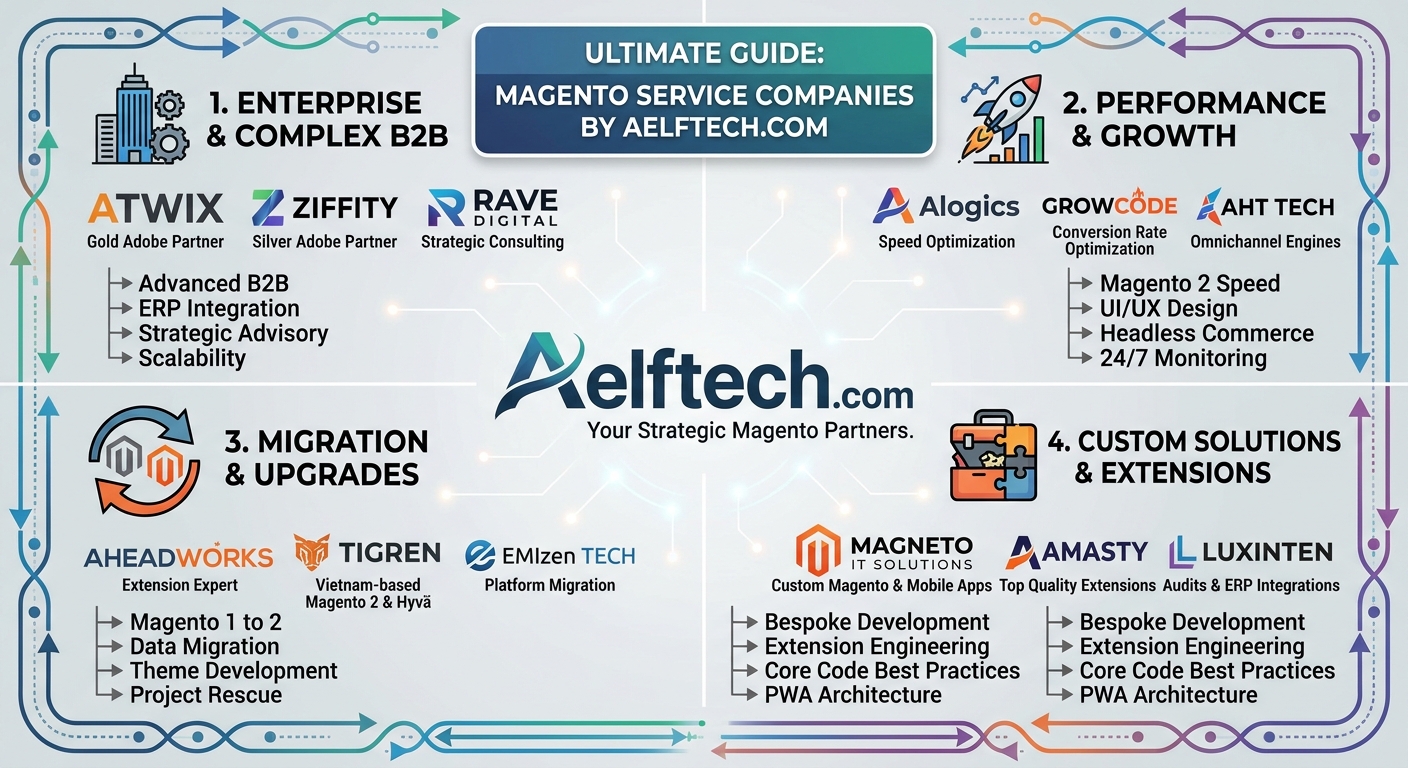

Choosing the right e-commerce development partner can make a significant difference in how an online store performs, serves customers, and grows over time. Businesses looking for Magento service companies by Aelftech.com may want to understand the company’s advertised Magento capabilities, the services involved, and the factors that matter when hiring an e-commerce development provider. Magento, now closely associated with Adobe Commerce and Magento Open Source, supports online stores that need flexible product catalogs, customized shopping experiences, payment integrations, and efficient order management.
Aelftech.com presents itself as a digital marketing and website development agency serving businesses in the United States and other markets. Its public business descriptions mention Magento services, website optimization, and e-commerce migration support. However, businesses should verify the depth of its technical experience before committing to a major project. This guide explains Magento services, Aelftech’s advertised offerings, project costs, essential evaluation criteria, and practical steps for choosing the right development partner.
What Are Magento Service Companies by Aelftech.com?
The phrase Magento service companies by Aelftech.com refers to searches for Magento-related services associated with Aelftech. The company’s public descriptions identify Magento support as one of its technical offerings, alongside digital marketing, search engine optimization (SEO), pay-per-click advertising, social media marketing, and WordPress development. Its website also discusses technical support, e-commerce optimization, and migration projects.
Magento service companies generally help businesses build, customize, maintain, and improve online stores. Their work may include storefront development, product catalog configuration, checkout improvements, payment gateway integration, and connections with inventory or customer management systems. Some providers also handle platform upgrades, technical troubleshooting, and ongoing maintenance.
For U.S. businesses, the right provider should understand both the technical platform and the practical needs of American e-commerce operations. These may include sales tax configuration, shipping rules, mobile shopping, customer data protection, and connections to existing business software.
It is important to distinguish between a company’s advertised services and independently verified expertise. Aelftech mentions Magento-related support publicly, but its available service descriptions do not establish the full scope of its Magento development capabilities. Prospective clients should request relevant project examples, technical references, and a written service proposal before making a decision.
Understanding Magento and Adobe Commerce
Magento is an e-commerce platform used to create and operate online stores. It provides a foundation for managing products, categories, customer accounts, shopping carts, orders, and other essential store functions. Businesses can extend these capabilities through custom development and compatible integrations.
The platform is commonly discussed in two forms: Magento Open Source and Adobe Commerce. Magento Open Source provides an open-source foundation for online retail, while Adobe Commerce offers additional commercial capabilities for businesses that need more advanced commerce features. The appropriate option depends on a company’s requirements, budget, technical resources, and growth plans.
Official Adobe documentation explains the platform’s development, maintenance, and migration processes. It also documents the importance of version compatibility, dependency management, and planned upgrades. Businesses can consult the Adobe Commerce documentation when reviewing technical proposals or discussing platform maintenance.
Magento is particularly relevant to merchants that need more flexibility than a basic online store can provide. For example, a retailer may need complex product options, multiple storefronts, custom pricing rules, or integration with an enterprise resource planning (ERP) system.
However, flexibility also introduces technical responsibilities. Custom modules, third-party extensions, and external integrations must remain compatible with the underlying platform. An experienced development partner should explain how it will manage those dependencies without disrupting daily business operations.
Magento Development Services Available to Online Businesses
Magento development can involve much more than launching a new storefront. Depending on the project, a business may need a complete store build, improvements to an existing installation, or targeted changes to a particular feature.
Custom Magento Store Development
Custom store development involves configuring or building an online shopping experience around a company’s products, customers, and operational needs. Work may include storefront design, navigation, category structures, product pages, customer accounts, and checkout workflows.
For example, a U.S. clothing retailer may need product variations for size and color, while a wholesale supplier may require customer-specific pricing and purchasing rules. The development approach should reflect these business requirements instead of relying on unnecessary customization.
Before approving a project, businesses should ask for a detailed scope of work. It should explain which features are included, which extensions are required, how the design will be approved, and how the completed store will be tested.
Aelftech advertises Magento services as part of its broader digital and website development offering. Companies interested in custom Magento development should confirm whether the agency can provide the required design, backend programming, integration, and testing work directly or through an external specialist.
Magento Store Customization
Store customization helps businesses adapt an existing Magento installation to changing customer expectations or internal processes. Typical tasks include modifying product pages, improving search and filtering, updating navigation, and adjusting the shopping cart.
These changes should improve usability without creating unnecessary technical debt. For instance, adding several extensions to achieve one simple function may increase maintenance costs and create compatibility problems during future upgrades.
A qualified developer should first review the existing codebase and identify the safest way to implement the requested change. The proposal should explain whether the work requires configuration, an existing extension, or custom programming.
Businesses should also consider accessibility, responsive design, and consistent behavior across desktop computers, tablets, and smartphones. These details can affect whether customers complete purchases successfully.
Magento Maintenance and Technical Support
An online store requires continued attention after launch. Maintenance may involve monitoring errors, reviewing logs, testing integrations, applying appropriate security updates, and resolving problems that affect customers or administrators.
Technical support can also help diagnose issues involving payment processing, shipping calculations, inventory synchronization, or product imports. However, the exact response times and coverage depend on the provider’s support agreement.
Businesses should ask whether maintenance includes routine updates, emergency fixes, backups, staging environments, and compatibility testing. They should also clarify whether support is available outside normal business hours.
Aelftech publicly mentions technical support and Magento-related services, but the available information does not define a complete Magento maintenance plan or service-level agreement. Companies should obtain these details in writing rather than assume that every form of support is included.
Magento Migration and Store Optimization
Moving an established store to a different platform version or hosting environment requires careful planning. Migration is not simply a matter of copying website files. Product data, customer records, order history, custom functionality, URLs, and external integrations may all require attention.
Aelftech’s public About Us page refers to e-commerce migrations and optimization as part of its advertised technical support. Nevertheless, businesses planning a substantial migration should verify whether the company has handled projects with comparable complexity.
What a Magento Migration Should Include
A responsible migration project typically begins with an assessment of the existing store. The development team reviews the current platform version, custom modules, extensions, integrations, hosting environment, and business requirements.
The next step is to define how data and functionality will move to the target environment. This includes identifying outdated extensions, unsupported customizations, and data that may need cleanup before migration.
Testing is equally important. The team should validate product information, customer accounts, order records, checkout behavior, payment processing, shipping calculations, and essential integrations. URL redirects should also be planned to reduce broken links and protect existing organic search traffic.
Adobe’s migration guidance emphasizes assessing customizations, data, storefront requirements, and integrations before implementation. Its documentation provides a useful technical reference for businesses evaluating migration proposals.
Improving Magento Store Performance
Store performance affects usability, customer satisfaction, and the efficiency of the purchasing process. Slow category pages, delayed search results, and checkout errors can frustrate shoppers and prevent completed orders.
Performance optimization begins with measurement. Developers should examine server response times, page loading behavior, database queries, caching, image sizes, JavaScript, and third-party scripts to identify the actual causes of delays.
Possible improvements include configuring caching correctly, optimizing images, reducing unnecessary scripts, reviewing database performance, and improving hosting resources. The best solution depends on the store’s architecture and measured bottlenecks.
Businesses should request before-and-after performance reports rather than accept vague promises of a faster website. Testing should cover important customer journeys, including product discovery, cart updates, and checkout.
Aelftech advertises website optimization, but clients should confirm whether a proposed engagement includes Magento-specific performance analysis, implementation, and verification. General SEO or WordPress optimization experience does not automatically demonstrate expertise in Magento’s technical architecture.
How Magento Development Supports U.S. E-Commerce Businesses
U.S. online retailers operate in a competitive market where customers expect convenient navigation, clear pricing, reliable payment processing, and accurate delivery information. Magento development can help businesses address these needs when the platform is configured and maintained properly.
Payment, Shipping, and Tax Integrations
Payment integration connects a store to services that process customer transactions. Depending on business needs, a merchant may require credit card processing, digital wallets, fraud screening, or other payment options.
Shipping integration can connect the store to carriers, fulfillment services, and warehouse systems. These connections may support shipping estimates, label creation, tracking information, and inventory updates.
Tax configuration also deserves careful attention. U.S. sales tax rules vary by jurisdiction and business circumstances. Merchants should work with qualified tax professionals when determining their obligations and confirm that the store’s tax configuration reflects the approved requirements.
A Magento development provider should document which integrations are included, which third-party services require separate subscriptions, and how transaction failures will be tested. The business should retain control of its payment accounts and other essential services.
ERP, CRM, and Inventory Connections
An ERP system can help manage purchasing, inventory, accounting, and fulfillment. A customer relationship management (CRM) platform stores information used by sales and customer service teams. Connecting these systems with Magento can reduce manual data entry and help keep information consistent.
For example, an inventory integration may update product availability when a warehouse receives or ships stock. A CRM integration may help customer service representatives access relevant order information.
However, integrations introduce dependencies. Businesses need to know which system is the primary source for product prices, inventory quantities, customer records, and order status.
Before development begins, the provider should map the data flow, document error handling, and define how synchronization failures will be detected. These steps reduce the risk of duplicate orders, inaccurate stock levels, and inconsistent customer information.
SEO and Conversion Optimization for Magento Stores
Technical development and digital marketing work best when they support the same business goals. A store may attract search traffic but still lose potential customers if its product pages are confusing or its checkout process is difficult.
Magento SEO includes several connected activities. These can involve improving page titles, meta descriptions, product descriptions, internal links, canonical tags, XML sitemaps, and URL structures. The exact requirements depend on the store’s current configuration.
Developers should also review indexation rules and duplicate product URLs. Faceted navigation, filters, and sorting options can generate many URL variations if they are not managed carefully.
Aelftech prominently advertises SEO, technical SEO, PPC management, and website development. Businesses seeking combined marketing and development support can discuss how these services might fit together. However, Magento-specific SEO experience should be assessed separately from general marketing capabilities.
Conversion rate optimization focuses on helping visitors complete valuable actions, such as making purchases or submitting inquiries. Improvements may include clearer product information, visible shipping details, simpler forms, and fewer unnecessary checkout steps.
Businesses should measure results using relevant analytics. Useful indicators include conversion rate, cart abandonment, average order value, organic traffic, and revenue by acquisition channel. No agency can responsibly guarantee a particular increase without considering the store’s starting point, market conditions, and implementation constraints.
How to Evaluate Magento Service Companies by Aelftech.com
Businesses researching Magento service companies by Aelftech.com should assess the provider using clear technical and commercial criteria. This approach helps separate advertised capabilities from demonstrated experience.
Review Relevant Project Experience
Ask for examples of Magento projects that resemble your own. A business-to-business store with custom pricing and ERP integration has different requirements from a small retail shop with a standard product catalog.
Request details about the provider’s role, the original challenge, the implemented solution, and the outcome. Where possible, ask for references from clients who have agreed to discuss their experience.
Portfolio screenshots can demonstrate design work, but they do not prove responsibility for the full implementation. Ask whether the provider handled architecture, development, testing, deployment, and post-launch support.
For Aelftech specifically, request Magento-focused examples rather than relying only on general SEO or WordPress projects.
Assess Technical Knowledge
A suitable Magento partner should be able to explain its approach to code quality, extension compatibility, testing, security, and deployment. The team should also understand the difference between configuration changes and custom development.
Ask how the provider reviews existing code, manages version control, tests changes, and handles failed deployments. A staging environment and a documented rollback plan are valuable safeguards for production stores.
The provider should also explain which team members will perform the work and whether any tasks will be outsourced. These questions help establish accountability before a contract is signed.
Compare Scope, Pricing, and Ownership
Do not compare proposals using the total price alone. One estimate may include discovery, migration, testing, documentation, and post-launch support, while another may cover development only.
Request a breakdown of deliverables, milestones, payment terms, exclusions, and potential additional costs. Hosting, premium extensions, software subscriptions, and third-party services may be billed separately.
The agreement should also state who owns the source code, design files, domain, hosting account, and project documentation. Businesses should retain suitable administrative access to their own systems.
These safeguards matter whether you hire Aelftech or another Magento development company.
Magento Development Costs in the United States
Magento development costs vary widely according to project size, customization, integration requirements, and the condition of the existing store. A small improvement to an established storefront is usually a different undertaking from a complete migration or a complex enterprise implementation.
The main cost factors include development hours, design requirements, data cleanup, extension licensing, hosting, testing, and ongoing maintenance. Projects involving ERP integration, custom checkout functionality, or complex product configurations may require additional discovery and engineering.
A fixed quote is useful when requirements are clear. For projects with uncertain technical requirements, a paid discovery phase or milestone-based arrangement may provide better cost control.
Businesses should request a written estimate that separates one-time implementation expenses from recurring costs. It should also identify assumptions, exclusions, change-request procedures, and acceptance criteria.
No verified standard Magento price list for Aelftech was identified in the available public information. Therefore, prospective clients should request a tailored proposal rather than rely on an unsupported price estimate.
Security, Compliance, and Long-Term Maintenance
E-commerce security involves more than installing a security extension. Store owners need a process for software updates, access control, backups, monitoring, and incident response.
Magento installations may contain custom code and third-party extensions that require regular compatibility checks. Outdated components can create operational and security risks, so businesses should know who is responsible for reviewing and applying relevant updates.
Adobe publishes release notes and upgrade guidance covering platform improvements, compatibility, and security-related changes. These official resources can help store owners understand why updates require planning and testing.
Businesses should also review access permissions and avoid sharing administrator credentials unnecessarily. Developers should use secure access methods, maintain appropriate code review practices, and document changes to production systems.
For U.S. merchants, privacy and payment requirements depend on the business, the data collected, and the services used. Legal and compliance obligations should be reviewed with qualified professionals rather than assumed to be covered by a development contract.
Before hiring a provider, ask how backups are tested, how security issues are reported, and what assistance is available if a production problem occurs. Clear responsibilities make ongoing maintenance easier to manage.
Is Aelftech the Right Magento Development Partner?
Aelftech may be worth considering for businesses exploring digital marketing and website development services that include advertised Magento support. Its public business descriptions mention Magento services, while its main website emphasizes SEO, paid advertising, social media marketing, and WordPress development.
That combination may interest companies looking for help with several parts of their digital presence. However, a business should not assume that a broad digital agency has the specialist engineering resources required for every Magento project.
The right decision depends on the scope of work. A relatively small optimization task may require a different level of expertise from a large migration involving customer data, multiple storefronts, custom modules, and enterprise integrations.
Before proceeding, arrange a technical discussion and request a written proposal. Confirm the assigned developers’ experience, project milestones, testing process, support arrangements, and ownership terms.
Aelftech’s published claims provide a starting point for evaluation, not a substitute for due diligence. The same standard should apply to every provider on your shortlist.
Frequently Asked Questions
1. What are Magento service companies by Aelftech.com?
The phrase refers to Magento-related services advertised by Aelftech.com. Its public business descriptions mention Magento support, e-commerce optimization, and migration-related work, but clients should verify the exact scope and technical expertise before hiring.
2. Does Aelftech.com provide Magento development services in the United States?
Aelftech presents itself as an agency serving U.S. businesses and lists Magento services among its advertised capabilities. Contact the company to confirm service availability, assigned developers, project scope, and support arrangements.
3. How much do Magento development services cost?
Costs depend on the store’s size, customization, integrations, migration requirements, and ongoing support needs. Request an itemized proposal that separates implementation costs from hosting, licenses, and recurring maintenance.
4. What should businesses check before hiring a Magento development company?
Review relevant project experience, technical skills, client references, testing procedures, security practices, and contract terms. Confirm source-code ownership, administrative access, project milestones, and post-launch support.
5. Can Magento development improve e-commerce SEO and sales?
Proper technical development can improve site performance, navigation, indexation, and the shopping experience. However, SEO rankings and sales also depend on competition, product demand, pricing, marketing, and customer behavior, so specific results cannot be guaranteed.
Conclusion
Finding the right e-commerce development partner requires more than comparing service descriptions or selecting the lowest quote. Businesses researching Magento service companies by Aelftech.com should understand the agency’s advertised capabilities, verify its Magento-specific experience, and evaluate the technical requirements of their projects.
Aelftech lists Magento support alongside SEO, PPC management, social media marketing, and website development. These offerings may be relevant to businesses seeking help with their wider digital presence. However, detailed project examples, technical qualifications, pricing, and support terms should be confirmed directly before hiring.
For U.S. businesses, the best Magento partner is one that communicates clearly, protects business data, documents its work, and delivers a maintainable solution. Compare proposals carefully, establish measurable goals, and verify important claims. This process will help you make an informed decision and build a stronger foundation for long-term e-commerce growth.

Archer is a caption writer with two years of experience creating engaging social media content. He specializes in Instagram captions, WhatsApp status ideas, creative quotes, attitude lines, and relatable expressions that help readers find the perfect words for every moment.
